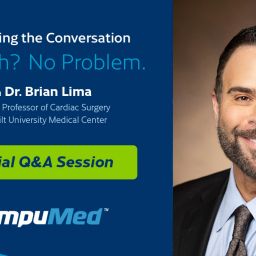
Discover how modern cardiac CTs can expand access to viable hearts.
A large proportion of potential DCD heart donors are never even offered—not because of true coronary artery disease, but because of the presumption that a cath is required to rule it out. Modern cardiac CT offers a practical, rapid, and informative alternative that can provide meaningful insights into coronary anatomy and overall heart viability.
In this provocative session, CompuMed expert advisor Dr. Brian Lima—a national leader in DCD heart recovery, NRP, and AI-enabled donor heart evaluation— shares how his team at Vanderbilt has successfully incorporated CT into donor evaluation. He breaks down when, why, and how cardiac CT can be applied thoughtfully, and unlock more transplantable hearts while maintaining rigorous recipient safety.
Welcome everyone to another CompuMed webinar. Today’s topic and guest is very innovative. And this topic is provocative so we’re excited about that. Just a quick admin. Please feel free to enter any questions in the little Q&A tab that’s on your screen.
And at the end we will be reviewing those and answering as many as we can. With that. So real quick, I think everybody has read Doctor Lima’s bio. Many of you on the call know him or know of all of his work that he has done to contribute to the heart transplant community. He’s a distinguished cardiac surgeon, a renowned leader in the heart transplantation
and the mechanical circulatory support. With that, I just want to hand it over to you, Doctor Lima, because there’s not much more I can say except, we’re so thrilled to have you. Not just on this, but also partnering with CompuMed now and in the future. Thank you.
Well, thank you all again for attending this webinar. Really a great topic. I’m excited to talk about it and get into it.
In consulting with coffee, the spirit of this has really been.
What can we be doing better on the donor vetting side to streamline. And at the end of the day, really, the difference we want to make is clarify and improve the donor vetting process and just get more life saving organs to the patients that need them. Really? That’s the spirit of all this. And this topic really encapsulates that pretty nicely.
No cath, no problem at what we’re talking about is how CT imaging really, I believe and we believe here at Vanderbilt, can transform the donor heart assessment process, particularly in the DCD population. So, I’ve been on Vanderbilt. I feel extremely fortunate to be a part of the Vanderbilt heart transplant team. We really have a tremendously deep bench of individuals all equally committed to doing whatever it takes to find a way to save the lives of the patients that are on our waiting lists for a lifesaving heart.
And very busy. We’re continually measuring and pushing the envelope. I think with a record breaking year last year in 2024, this year, it’s at a faster rate of that. We’re up to almost 200 and hope to be at the end of the year and up to 200. And I think nothing tells a story of kind of how we manage to push the envelope.
Then really, our journey with NRP. NRP has been a tremendous source of growth for us and for transplant in general. Our transplant in general. And in this recent publication early this year in Journal of Heart Lung Transplant, just briefly kind of summarizes some of the milestones that we’ve had in our program. We starting off pretty conservatively, as at most, with NP but over time, maybe going further away.
So longer scheme at times. Also entertaining donors that are older, things of that sort. And that’s kind of where we get into the story about CT vetting of coronaries and, not to be, you know, Captain Obvious, but you can only accept the donor hearts that you’re offered. So, part of this issue is that there’s a lot of donor hearts.
There aren’t even offered. And this is beautifully kind of summarized in this recent publication, also this year in Journal of Heart Lung Transplant by Nader Moazami’s group up at NYU. And they basically took a snapshot 2023, all DCD donors, about 4000 of them under the age of 55 and what’s staggering is only 16%, about 650 were recovered for heart transplant.
If you go over to the left, there is now 2500 or so were not recovered. And when you apply or when they apply the SRTR heart yield model it identified anywhere between 700 and 1200 non utilized DCD hearts that had characteristics comparable to transplant cases. And you know in addition in that manuscript they also talk about the trends that have been occurring within DCD.
And you could see on the left graph starting in 2019, that red curve is when you start to see actually transplanted DCD hearts. That makes sense. That’s when the TransMedics trials in place. And really got us going in the United States of DCD heart. The black curve shows the number of donor hearts not recovered. So does DCDs in general under the age of 55.
And on the right you can see the median age of DCDs by a year. And you can see the median age is going up. Beginning in around 2019 was 26 years of age. 2023, 32 yet for some reason, the rate of heart transplant, DCD heart transplant is by far away being outpaced by the rate of non recovery.
And I can’t help but wonder as I’m sure many of you do. It’s one of the main barriers driving this is the access to interventional, you know, a cardiac cath or coronary angiography, ICA as we’ll refer to it throughout this presentation and kind of where does coronary angiography fit in? And really it’s for vetting donor coronary arteries, making sure there’s no coronary artery disease.
And you know, when you look at try to find guidelines for this, this is the most recent set of donor heart selection guidelines published a couple years ago. And I’ll in the end quote, I’ll say, while there are no evidence based findings with respect to coronary angiography, it is reasonable to consider performing this test in donors who are considered to have high risk for coronary artery disease.
This is really a consensus level, level of evidence C recommendation class 2B, which does leave a lot of wiggle room. There’s not really a definitive, hard evidence based recommendation related to coronary vetting. And I would argue that coronary angiography or the desire to get one or the perceived need to get one in certain donor vetting scenarios is likely the number one operational bottleneck in DCD heart recovery.
And I think where we kind of go forward with this presentation.
We’ve done our best at Vanderbilt to circumvent this, to navigate this. Of course, we want to try, to the fullest extent possible, to rule out donor coronary artery disease and often in the DCD realm, it’s logistically or ethically not possible to get an invasive procedure like cardiac cath. So this case, published earlier this year from our group in the ASAIO is the first case where an interop cardiac cath was done in a DCD donor during NRP and this is a scenario where we saw on the cardiac CT a non contrast chest CT.
And we talk a lot about chest CT throughout this presentation. You can see on that top panel the little white speck delineated by that arrow is what was concerning for some calcification or plaque in the left anterior descending coronary artery. So the stars aligned. And as luck would have it, this donor was at our hospital at Vanderbilt.
So what we did to formally evaluate that concern for plaque that was visible on this non contrast chest CT was actually do a coronary angiography during the NRP run. We had our interventional cardiologist in-house come and do it. We just basically rolled the fluoro machine into the operating room. And we were able to still use that heart, it went
okay. But as you can imagine, while this was great and it worked out, this is really not logistically, feasibly, something that could be the be all, end all solution in the vast majority of cases that we encountered in our world. And what’s the whole reason why are we so worried or concerned for making sure there’s no occult coronary disease?
And, you know, it sounds like it’s the question, but there’s really two answers to that. The first answer is, we want to make sure obviously there’s no plaque, no atherosclerotic plaque. Something that could obstruct a coronary that we don’t know about, obviously, that we would see short term, pretty early complications related to that.
But really, what drives the desire to do cath more than anything in the scenario we run into more often than not, is making sure there aren’t any lumps and bumps throughout the coronaries, meaning not actual occlusive disease like occluded coronary, but some areas of calcification, non-occlusive coronary disease that could play a role in long term outcomes, namely cardiac allograft vascular apathy.
CAV with a V as in victory. And CAV is responsible for one third of deaths beyond a year of heart transplant and occurs in about a third of recipients five years after heart transplant. And so that’s really the reason, not necessarily ruling out the obvious, totally occluded coronary. It’s really making sure there’s not some areas of calcification that could be cause of concern for later on down the road, years down the road.
Some chronic rejection, ie CAV. But what’s interesting, and I think this is the part of the presentation where we actually do a bit of a detour outside of kind of the world that we all are immersed in. And I think this will be particularly eye opening for folks in the OPO space.
The way we actually vet for CAV itself, long term issues of transplanted hearts where some progressive occlusion of vessels could occur, is actually increasingly not with cath, not with invasive angiography, but actually with coronary CT angiography, the CT scan. And this is actually a publication this year by our group at Vanderbilt led by Bruno Lima, who’s a cardiologist.
And, I’m sure he’s sick and tired of getting calls from me and vice versa. We get mixed up all the time. Cardiology. Cardiac surgeon. Same initials. Same last name. At any rate, that’s neither here nor there. But this study basically showed that CT angiography is a very effective way to surveil for post heart transplant CAV.
Now, this has not been studied in donor heart assessment per se. And some of the drawbacks that you could identify right off the bat would be the fact that these are gated to heart rate. So it’s part of the protocol for doing these very sophisticated CT scans is you gate it to the heart rate. There is a contrast dye load.
But an important point here is it’s about half as much as the dye load for an invasive classic coronary angiography. And really, the more important practical limitation here is that your usual small town hospital may not have the capability or the scanner or the protocol or the individuals to read it, to perform this particular test.
But it’s just very eye opening that we’re not, that increasingly invasive cath angiography is not really the go to test to surveil for coronary or cardiac allograft vasculopathy. And then in another area that’s pertinent is in the world of transcatheter aortic valve replacement. For those of you that are familiar, many aortic valve replacements now are done with a catheter, meaning we’re not opening the chest doing open heart surgery.
We’re actually using a catheter with a valve mounted on the catheter and deploying that aortic valve inside the native, our prior aortic valve replacement. This has really transformed the field of aortic valve surgery. And, you know, at Vanderbilt and I’m sure at many other hospitals throughout the country, we see upwards of 50 to 100 patients, maybe even a week, who are being evaluated for candidacy for these procedures.
And how do we actually vet for coronary disease, which of course we have to in these patients, is through CT scan, the same CT scan that I mentioned before. And this beautiful study, published a couple of years ago in JACC by a Cleveland Clinic group. This was the largest study of its kind, but it looked at 2000 patients who were being evaluated for TAVR and mind you, many of the TAVR patients are elderly, a lot of comorbidities, renal insufficiency often and heavily calcified aortic valves.
And even in these cases, the negative predictive value for a clean coronary CT is 97%, which is very, very sensitive. And that’s pretty impressive. I’m just kind of throwing this out there. I’m going to tie this all together. But again, something to keep in the back of your mind for this high risk population, extremely high risk population for having concomitant coronary disease.
Our go to initial screening tool is not an invasive cath, but actually CT angiography.
But as I mentioned, there are challenges with those CTs. They’re gated to the heart rate, contrast dye load, etc., etc. but as explained and demonstrated here in this state of the art review on CT scan techniques in general for assessing coronary plaque burden, you can use non contrast chest CTs. And I have it boxed here in red.
But you can do coronary artery calcium scoring. We’re going to talk a lot about that. And you can get coronary artery calcium scoring from any non contrast chest CT even if it’s not gated. So your garden variety, run of the mill, any hospital can do a non contrast chest CT. You can derive coronary artery calcium scoring from that scan.
And the significance of that is that these results, these scoring strategies strongly correlate with risk for coronary events and really represent the ideal approach for rapid donor screening. The initial example I mentioned, where we did that cardiac cath on that donor, is because we saw some calcium, a speck of calcium, on that non contrast chest.
Chest CT and it guided further therapy as shown here on the right. There’s a red arrow there showing this tiny little white speck of calcium. And that prompted a CT angio and a more sophisticated test that we’ve been talking about. And that pinpointed some lesions. So this could be a very easy, simple, widely available approach to then determine if there’s no concern at all, no calcium, or maybe there is a little bit of calcium.
And should we test a little bit further and still potentially in a noninvasive way.
And then of course, with AI and I’m sure AI upon us, there’s a whole proliferation of other approaches, quantitative automated AI driven approaches, which obviously MOSAiCC has with CompuMed. I have something to say about that, getting into that later. But there’s the potential for having this sort of very high level, sophisticated interpretation of coronary plaque being automated and also derived from routine chest CTs.
And back to the non contrast chest CT, the simple chest CT that you can get that most donors get. This is the scoring system. It’s a visual assessment. There’s really none shown on the right on panel D. None, mild, moderate and severe. And in cases where there’s more than none, that could potentially guide additional vetting. But at least if you saw none initially.
Well, there’s very few centers, I think Vanderbilt of course included, that would turn down that heart even if there was a plethora of risk factors. And again, non contrast chest CT, if you could do coronary artery calcium scoring, reliably identifies patients at risk because it reliably identifies coronary calcification and it correlates with total plaque burden. So an important test. I think the missing piece, the missing element right now in real world practice is that we’re sort of doing this as an eyeball test.
We’re not doing the actual, you know, at two in the morning, you’re not getting the calcium score for the coronaries. You’re basically looking grossly for any evidence whatsoever of any calcification, as evidenced by any sort of white speck. Because of that, that’s what you’re doing really in real world practice right now.
But the last part of the detour is, this is pretty widespread, this idea of screening for heart disease, getting your calcium score done. A lot of hospitals all over the country advertise, you know, you have a Father’s Day gift, $49 for a heart CT calcium score screening special. This is all over the place.
So this is a widely available approach that I think as a field we’re not taking advantage of at all. This can be easily incorporated into our current workflow of donor assessment. So another plug, which we’ll get into later. So back to kind of our world transplant. At the end of the day, the vast majority of donors get a CT.
Non contrast CT and even some get contrast chest CTs. But a lot of the data that we need to vet coronaries is already being acquired. We just haven’t been using it or using it to its full potential.
And as far as the extent that this has been studied previously, there’s really not a lot out there. There’s data from Cedars-Sinai. This was presented at ISHLT in 2021, where they looked back at their patient population, 200 patients without any coronary calcification, and then 30 patients with coronary calcification. And as I put it in the red box there, the three year freedom from any evidence of CAV.
Right. Which is what we’re worried about, was 65% versus 86% in those without calcification. So that makes sense. The donors that had calcification, they ended up having significantly more CAV later on. But and kind of beyond the scope of this presentation, another really important fact to note here is that the survival really wasn’t impacted by this small level of calcium.
Three year survival in those with coronary calcification, 87% was actually higher, obviously not statistically higher than the 83% for those without coronary calcification. And it makes you think. But still, yes, the risk is real for developing CAV down the road. So in our efforts to try to really push the envelope, work with the system, try to find ways to find great hearts to save lives of patients on our waitlist.
We’ve been doing these sorts of analyses because we quantify and measure everything we do to really get a better sense of, okay, what’s safe? What can we do? And as I mentioned, there’s some evidence out there about the diagnostic proficiency and capabilities of just non contrast chest CT and of course with contrast chest CT. We’ve been using donors without formal donor coronary angiography for some time.
And this is a study that we’ve just submitted as a manuscript to Journal Heart Lung Transplant. And this is a summary of our experience over five years, over 500 patients. So this is the largest study of its kind ever published.
We hope it gets published soon. And within that 500 patient group, 200 patients had invasive angiography and 300 patients had CT scans. Within the CT scan group, 40% had no contrast and 60% had contrast. And the outcomes that we studied were severe primary graft dysfunction. So that’s basically the need for ECMO for a very poorly functioning heart within 24 hours, the need for any mechanical circulatory support within 72 hours,
and mortality at one year.
As we found, these are sort of apples and oranges. You’re not comparing apples to apples here in both of these groups. Not surprisingly, in the CT scan group, you had a lot more patients or donors that were DCD, so among the DCD donors, 50% of them had a CT only as their vetting
for coronary approach. There were some other differences noted there.
As you’ll see, there are statistical approaches to overcome these differences between these two groups. But again, not surprising that most of the over half of the DCD donors had a CT only way of vetting for their coronaries.
As far as key clinical endpoints, unadjusted outcomes. So when you compare the cath group to the CT group, similar rates, low rates of severe PGD, the need for balloon pump within 72 hours was higher in the CT group, which we’ll get into. The need for ECMO within 72 hours was low,
similar for both groups. 30 day mortality low. It’s actually lower in the CT group, but statistically more or less the same. And the one year mortality also low and similar between both groups. So really the takeaway from at least these unadjusted outcomes, we’ll get into the adjusted outcomes shortly. Early graft function and mortality were similar.
And to touch on the balloon pump signal, when we did a weighted regression to adjust for the differences between the donors in both groups, the CT group and the coronary group, again, similar effects, similar findings short term as far as outcomes: severe PGD, VA-ECMO required within 72 hours, 30 day mortality, one year mortality. There was still a higher signal for needing balloon pump, and I think that’s really more of a reflection of it being a DCD rich cohort rather than a clear signal of missed CAD.
And as you can see, it didn’t translate into earlier or increased mortality in the short term or within a year, which, if you look at the literature in DCD, jives with what we’ve seen. So that’s one important takeaway. The other two important takeaways were, well, we did sensitivity and robustness checks.
There really was not a donor age interaction meaning whether the donors were less than 40 or over 40. That’s a classic inflection point, right, where you’re really trying to vet coronaries 40 and older. You really want to know formally, the best you can, the status of the coronaries. There wasn’t really any difference with regards to severe PGD or mortality. And within the CT group, non contrast versus contrast, the outcomes were also comparable.
And then an important group obviously as I mentioned, the donors 40 and older. That’s the group that everyone stresses about. Okay. How are we going to vet the coronaries? That balloon pump signal is there. And again, that’s because a lot of these donors in that CT group, that was really the only way available to vet for coronary disease, DCD 40 and over.
Really difficult to get caths in many instances because of ethical and logistical reasons. But that did not translate into increased severe PGD or increased one year mortality, low in both groups. So again, take home message. Even in the 40 and older group where CT was often the only feasible screening option, there was no obvious mortality penalty associated with CT based coronary vetting.
And then when you go and do a deeper dive in the CT cohort itself comparing non contrast to contrast, again, similar outcomes with regard to severe PGD, balloon pump, VA-ECMO within 72 hours and one year mortality. So really no differences when you compare the two different ways to do CT.
And I think putting this all together, really, and I hope we have some time to answer questions and have some discussion, I think a pragmatic CT first adoption path for OPOs obviously is starting with a non contrast chest CT for all donors. But I think with that you’d have fewer missed opportunities. You would have increased DCD utilization because there’s no telling, and I’m sure many of you will tell me, how many donors don’t even make it to being offered just for the presumption that, well, they’re going to want a cath.
So, if we have a non contrast chest CT, that may be all we need. So that’s one piece of food for thought as far as working through the algorithm. A CTA, a step up with contrast gated if possible for donors 40 and older or that have some evidence of risk, potentially maybe on that non contrast chest there’s some evidence of calcification.
It wasn’t zero. Okay. Then the vetting could progress to that level, still noninvasive with a CT scan. Then of course intervention, you know an invasive coronary angio, still obviously an option. Much easier path in brain dead, but not necessary as we pointed out here. And on occasion, we are able to get them for DCD donors with cath if possible, but again, not necessary if we have CTA, really driven by something seen or observed in the non contrast chest CT.
And of course ideally you would have some centralized CT ingestion pathway and review process that would span all hospitals across the country. And within that framework you would have an AI enhanced automated coronary artery calcium scoring system to facilitate coronary assessment and to give you the easy sort of lob it over the plate at two in the morning, you know, CAC scoring zero.
So.
And really to operationalize this across all donor hospitals, you have a couple of technical things. You would need an approach to enable rapid Dicom ingestion from any donor hospital. And then some standardized way, again centralized, of reconstructing those images to enable visual CAC grading and of course, to make it practical and usable at 2 in the morning.
You want this to facilitate remote real time viewing by the vetting recipient hospital, the surgeon, cardiologist, whoever on that recipient team, easy access and secure access. And everything timestamped and documented.
But finally take home messages just to close out, not being able to do cath does not make a donor heart unofferable. I mean, that’s point number one. Number two, CT is safe, scalable, and it’s already been done for most donors. A non-contrast chest CT is an excellent universal minimum screen. And as we’ve shown here with our Vanderbilt experience, CT is largely equivalent to invasive coronary angiography for early and one year outcomes.
Of course, future studies are needed so we can assess longitudinal outcomes, namely CAV. But again, can’t overemphasize that. I firmly believe that a CT first approach removes what I think is the number one barrier to at least DCD heart expansion. And in a future state, it’d be amazing to have a national rollout of an AI enhanced centralized image acquisition pathway for processing, reconstruction and interpretation.
I think it would really be transformative for the field and obviously have massive impact for recipients on our wait list that we’re all caring for. And thank you. I’ll finish there. Thank you, Doctor Lima. We have so many people already asking for more information for slides for follow up. So this isn’t the beginning of this.
I’d real quick like to introduce, Lee Keddie. He’s our CEO of CompuMed and Yvette Chapman, who is a consultant. Many of you may have worked with her in donor and transplant, are going to spend some time with Doctor Lehman going
over a list of questions in the Q&A at this point. So thank you.
All I got to say, Doctor Lima, that was absolutely fantastic. I can’t imagine how there’s not so many people kind of scrambling at what? Wow. How do we implement this? Because this has so many implications in so many areas. Wouldn’t you say that? Absolutely. I mean, this is such an outstanding and forward thinking and forward looking presentation.
I mean, first of all, every donor already receives a chest CT. That just means the data needed for screening is already being captured. We’re just not leveraging it consistently.
You know, Laura, there’s a whole bunch of questions here. Do you want to start going through them? I mean, there’s probably 15 or 20, so, we’ll just see how much time we have.
But I think it’d be good to get started.
Okay. So first, and there’s names here on it, but I think if we can kind of group some of them together, does the CT based coronary screening impact the risk of early graft dysfunction or need for mechanical support?
And some of these you’ve answered to some degree. But yeah. So what we saw is, in the DCD population, we have seen, and that’s specifically DCD, not necessarily an issue related to donor coronary disease, is that they may behave in such a way where they, at least what we saw, needed balloon pumps early.
But really, that did not translate into early mortality, one year mortality or severe primary graft dysfunction. So in that regard, the early outcomes were the same. How about, it says here what proportion of currently non-US DCD hearts do you believe could be salvageable with CT first adoption? And I think that was that 700 to 1400.
Yeah. So it depends on, if you’re a believer and put a lot of stock in the SRTR heart model, it’s just an approximation. But yeah, I think if you split the difference maybe a thousand donors a year potentially. And of those, if a portion of those were over 40 as an example, maybe the under 40 you have the opportunity to use the basic CT scan. If you see something there, then you’d be looking for the CTA.
Is that right? I think, you know, we look at everybody’s CT. So even if an 18 year old, if their non contrast chest CT that pretty much almost everybody gets, sometimes donors will get a PE protocol chest CT because maybe they came in through ER or whatever it is. But as long as we don’t see any calcium at all on a non contrast chest, whether they’re 18 or 50, I’d be hard pressed to say, oh boy, we really need to, if we’re told a cath is not possible.
Vanderbilt. We’ve taken those hearts all the time, meaning there’s absolutely no calcium on the non contrast chest CT. I think I’d be hard pressed to turn a heart down. Obviously you’re going to do a very detailed gross visual inspection and palpation of the coronaries on site when we’re looking at the donor heart grossly right in front of you.
But we’ve done that. Young or not so young. But in an ideal world, yes, if you can, a CTA and coronary that, and we’ve done that too where we’re like, hey, there’s a little bit of calcium or really worried about risk factors here. Can we get a coronary CTA or chest CT, something with contrast, just to help look a little more closely at this donor.
And if that is possible and that’s clean as well, then we feel even more confident about taking that heart. But again, this is in a world right now where we’re not really using, as I said, the official kind of formal calcium score. I’m a knuckle dragging cardiac surgeon. I can’t calculate a calcium score. I can look at the scan and say, I don’t see any white specks when I put it on the bone windows, so there’s no calcium in the coronaries.
Okay, great. But what do you do when you see a speck here or speck there? That’s kind of where this is going to come down to. And if you can, it doesn’t necessarily mean you need a cath, you can still get a contrast enhanced coronary CT. So I’m going to jump in here with another question that just came in live.
I think it’s very timely. This says, Yolanda Becker, an abdominal transplant surgeon and CMO at an OPO. We always get a CT and it is uploaded. How can we be sure a decision maker is actually looking at the scans? Several third party vendors will not even give us the contact information. Everything’s located in unit… well, no, that’s a question for me.
Yeah, that might be a question for us. So that’s a very good point. Just to give you an idea, on our platform, we know every click that is blown through as far as the image shares. It’s very interesting. We’re seeing more and more how valuable the CT is.
And this is an obvious one. In a novel way over and over and over again, the CT has become more valuable for structure and those sorts of things. So we see in our metrics CTs are viewed somewhere between 30 and 50 times for each share.
And that’s really important because all these programs are looking at it now. As far as a specific program, we actually can keep track of that based on the IP address, but it is something that would add more value if you can actually see the person themselves and I know that in a lot of ways, that’s an issue for data in general.
Is, are people looking at it? On the flip side, we’ve been talking to a lot of transplant programs and they will ask for some information, and it might be 12 hours later, and they don’t know if the information has been updated. So it kind of goes both ways on the communication side. But I think honestly right now, wouldn’t you say, that’s why there’s a lot of phone calls and texts back and forth directly to people. 100%, that’s the reason.
Yeah. And also again, I think changing the whole paradigm. If we now evolve to paying attention to this metric, coronary calcium, let’s say on a non contrast chest CT and report it out kind of always on the reading. If you’re looking at the donor highlights and you look under a chest CT or whatever it is at the top right, you know, no coronary calcium visualized or and calcium score was X, etc., that would help.
And then of course if we move a step further and facilitate image acquisition. Right, we’re on your phone, you get pinged. We could sort of run through really quickly and see, maybe reconstructed images where you could sort of see it in a different way to clarify. That’s what all these reconstruction programs do. They’re able to take the coronaries, for example, when we do these pre TAVR evaluations, they’re able to actually do all these reconstructions to let you see the whole straight line of the coronary.
As opposed to having to scroll through each slice to keep following the coronary. It just does it for you. So now you see the whole thing and like, okay. Yeah. Looks nice and straight. Don’t see any plaque. Okay. I think this is pretty good. Maybe reassuring. There are three questions here that are kind of combined that I think you could maybe answer together, and that is around adoption, if you will.
How many heart centers are using this technique? Will this information be adopted widely by transplant surgeons and cardiologists? And the other one that is similar, how should OPOs counsel transplant center teams who are hesitant to accept CT screened only donors, especially those greater than 40? I think those kind of all go together in adoption. And how do you get, if this is something that Vanderbilt’s doing, how do we get it so that other organizations will also see that? Some of it is just going to take some time.
And that’s our hope with writing up our experience and sharing it publicly and getting it published. That’ll be one. So just dissemination of information and our experience. But of course, like everything else that’s novel, you’re going to have early adopters and you’re going to have people who are going to really wait for a lot of evidence to accumulate.
But that’s why it’s called a list, a wait list, where you keep going down the list. I think the take home is, whether it’s us, whether it’s another aggressive program, a lot of aggressive programs will be okay with not having a cath and using a CT based vetting strategy. So that’s definitely another take home message. And you worked with other programs, transplant programs, in showing results when you were at STA and showing maybe ones that programs had passed up on and had got transplanted elsewhere.
That was kind of in that vein, wasn’t it? Absolutely. I think at the end of the day, it’s going to be taking the results, just like from Doctor Lima’s program of, you know, this is what our outcomes are utilizing this technology. And just in the presentation he had here, he was showing the percent CAV that he had.
And I think that’s what it is. It is showing the result outcome after a period of time. And that is the only thing that’s going to change the mind, having empirical data to show. And I guess there’s that part of, back in the start, Doctor Lima, you showed that slide of, you know, we’re trying to drive down surprises when people accept and regrets when they don’t.
There’s that regret when they see Vanderbilt saying, hey, no cath, no problem. We’ll take it. Right. That you really are committed to the numbers that you have and people can see that. But a lot of it is education and that’s even why this is happening here. It seems like a lot of things that have been asked for, that’s the way we’ve always done it.
And maybe it’s gold standard, the heart cath. But when you dig into the real why, you’re looking for vasculature information. And why? Because of the graft failure later on. And so if you can find other ways, we were just at RSNA, one of the world’s largest radiology shows and the amount of AI coming out on imaging, and it’s substantially around CTs and even the basic standard CT, the amount of AI that is coming out that is advancing our ability to see things that are hidden in that imaging.
And it’s really amazing. So more and more this is going to accelerate. It’s not just this with the heart. There’s all sorts of things, whether it’s lung nodules or vasculature of the liver or whatever it is that you can get from these CTs. And I mentioned too, that a lot of these hospitals, because one of the main take homes also was sure, wouldn’t it be great if you can get the super advanced fancy 3D coronary CT everywhere?
And that’s not realistic. But on the non-contrast chest CT, there’s a lot of hospitals that, like I was trying to kind of jokingly say, are doing a lot of advertising, “Hey, we do calcium, come get your heart check here,” etc. Those two areas are totally, we’re not marrying them yet. So, I think to whatever the questions around how do we get other people to buy in?
Well, right now we’re not reporting out coronary artery calcium scoring. We could change that, that would help. Maybe some folks sort of in the middle of the road say, oh, okay. Oh, wow. You guys are doing that. The coronary calcium score is zero. We can’t do a cath, but this could change our minds for sure.
But we’re not doing that. There are a lot of live questions kind of along the same lines. How do we convince? How long before you do… I just got one corollary on that, maybe first. Okay. I think this is really eye opening for OPOs, but, Yvette, on the OPO field, a lot of OPOs, if they have a DCU or they’re thinking of having a DCU, some of those, a lot of those do not have a heart cath lab.
Some do, but a lot do not. And they’re delaying moving the brain dead donors until they can get a heart cath if they’re looking at the heart. This could be a way where they use the CT. If there’s no calcium at all, then if this is adopted, they can move much sooner rather than having to wait for a heart cath, even if they could get one.
But it’s delaying that time to move to the DCD. And Doctor Becker said this as well. You just don’t have the time many times to wait for that. So this could be a game changer by being able to just get the CT and have the calcium score, because it could speed things up. Exactly.
You said there’s some more questions. Yeah. And again, a lot of this is about how we change the thinking, how to adopt the new protocols as a way to think of it. One, how do you convince OPOs to obtain CT coronaries or cath with certain risk factors to increase ability to donate?
I’m sorry, to increase the ability to donate. Another is, how long is a CT or CTA good for evaluating? I do like this question though, Jessica. If we utilize CompuMed at our OPO, can we have CompuMed read our CAC? Again, a lot of this is protocols that I believe we’re going to have to work through.
And there’s Doctor McCauley. Matt McCauley, medical director at WIUW, associated OPO. He had some specific, assuming reassuring echo and benign cause of death. What range of calcium score would you expect to be a good ballpark for eventually offering a heart without an ICA? For a 40 year old donor with risk factors, for 50 year old without risk factors, I think it’s some more general, how do we start to put parameters at the start? So if you remember it’s none, mild, moderate, severe. If that same 40 year old with risk factors has none.
Why not? Right now where I think things get gray is mild. Obviously if you see moderate or severe, that’s maybe where you would still want to insist, oh boy, we got to get a cath, etc. But I think where the gray zone is going to be is mild. Okay, how do we vet this a little more?
What is mild? Why is it mild? In that instance a CT with contrast could vet that even further. It doesn’t necessarily mean you have to jump to an invasive if it’s not an option, when you do what you can. It’s kind of like thinking, I hate to use this example, but it’s somewhat similar, maybe not so much of a stretch, to the best testing we have. This donor is hep C negative and HIV negative with the most advanced sensitive testing that we have right now.
But they were found with needle in arm. How do we know they didn’t just inject themselves with hep C or HIV? Sure, that’s a risk. It’s a risk. But it’s a non-zero risk. But it’s a very low non-zero risk. So I kind of adopt the same framework of thinking for, okay, you have a clean totally zero calcification on a non contrast chest.
The likelihood that that person is going to have some rip roaring plaque somewhere that’s going to cause a problem is pretty low. Is it zero? Maybe not, but it’s a pretty low number. And it goes back to risk factors do not equal contraindications. And I love how in that example you give, it’s bringing some certainty in both sides of the goalpost.
So on the one, there’s no calcification and they’re young. It’s like, hey, we would have not gone after this before. And so you don’t have a regret. And then the ones that are, you see calcification, you can put them more onto, okay, I didn’t go and was surprised. And then now it’s a dry run.
And so yes, there’s still, but instead of this large amount that is unknown and just not gone after, now you can take those two off and now you have a smaller one and you have an alternative to a heart cath, another option as well. So all of a sudden you have a way of granulating down that.
And that’s actually where MOSAiCC comes into play, where you can ingest all this different disparate data and you can throw at it in an AI form of a prompt and you can get that information out. And you’re not drowning in the data. So, that’s actually, no matter what, got to be wonderful for an OPO to hear that there are ways of disseminating decision making on the heart.
Yeah. And also keep in mind, I didn’t explicitly state this for the presentation, but a lot of the patients where they had contrast, it wasn’t the fancy coronary gated. It was maybe a PE protocol chest CT. There’s some contrast, but it’s not this protocol super sophisticated one. So it’s sort of a middle ground between non contrast and the ultimate coronary CT in the CT realm.
So any hospital could do that. Any hospital could do that. We were seeing at RSNA, there’s some AI software now that’s looking at emulating gated when it’s not gated. So this is where this stuff is going. Tricky workarounds for this where you’re going to start getting to a point where it doesn’t matter where the donor is, any hospital or any CT scanner can do this.
Does it matter at what phase and at what point the CT is done? Because it could have been done when the donor first came in. Or does it need to be later? Unlike echo, this is where it’s definitely different. Echo can change the function. There were chest compressions, the heart could be beat up a little bit and now their heart is getting stronger and better over time.
The CT stuff like the angio stuff, that’s static. That’s not going to change in four days, five days or whatever. It is what it is. And you know that. But the corollary to that is, of 100 potential donors, there’s one donor. And of those 100 potential donors, there’s maybe 18 conversations.
There’s a whole opportunity for potential donors to get CT information. Yes. And review that. And it’s not going to be in the EMR. It’s not going to be in the report that we need the CT. And that’s why the direct connect is so valuable. Because even though you’re not in the hospital for potential donors, you can ask for a CT that was done even though they’re not a donor yet.
And we can operate on that CT. I would venture to say that the biggest potential, the biggest missed potential is the ones that were not even being vetted at all. Yeah, the whole main, remember 16% and then in transplant 16%. So even if some mind shifting and processing on evolution here, and we say, well let’s take a closer look at more of these or let’s offer more of these up with just chest CT alone knowing that, okay, if they want a cath, well, at least there’s going to be
a sizable increase of viable good donors just by doing that. So there’s a comment from Doctor Becker, which kind of ties into it before we wrap up. We have to work through the allocation scheme and taking repeated talk repeatedly to a third party that is following an algorithm is a real issue. I hope this is presented at ISHLT or in a way that there is agreement with your colleagues and cardiologists.
So, Doctor Becker, I think we’ll be talking to you. And then there’s the here and now and I’m sorry, Stacy, I don’t know what your role is, but very specific on how do you convince the OPO to obtain CT coronaries or cath with certain risk factors to increase ability to donate?
I mean, it ties into the same thing. So it’s the mind shift is what you’re saying. We got a lot more questions. Maybe we can answer some of them offline. Doctor Lima, I know you’re extremely busy. But there’s so many here. And we’re going to share the webinar. Of course, I would just say, this to any transplant programs people listening.
So many things that are being asked for are proxies, they’re things that when we know why you’re asking, there’s lots of novel ways of providing those answers. So, we’re all ears. We would love to hear from you about what you really want to know and why you want to know it. Because there’s so many opportunities, especially from some of these very rich imaging platforms, etc., to get that information in a different way.
You know, for example, if you’re asking for BMI for height and weight to estimate fatty content of the liver, or for volume of the liver, we can do 3D volumetric from the CT. So there’s so many ways, once those images are centralized in a platform, that we can give you information like this.
That is not what’s typically been gone after. But you get the answers that you need to make a decision. And so that’s great. Thank you again, Doctor Lima. And especially for your commitment to advancing what we do in donation and transplant. My pleasure. Thank you for having me. And like I said, feel free to reach out if you have any questions or comments.
Sounds great. Thank you everyone. And we will be sending a follow up rebroadcast of this and taking the questions. And we’re having Doctor Lee help us answer all those and get them out. So we really appreciate everybody. Thank you. Have a great day. Good day guys.
Continuing the Conversation:
Special Q&A Session
In response to the number of insightful questions submitted during the live event, we hosted a dedicated follow-up Q&A session with Dr. Lima.
Brian Lima, MD, MBA
Associate Professor of Cardiac Surgery
Vanderbilt University Medical Center
Dr. Brian Lima is a distinguished cardiac surgeon and a recognized leader in heart transplantation and mechanical circulatory support.
Before joining the faculty at Vanderbilt University Medical Center, Dr. Lima served as the Surgical Director of Heart Transplantation and Mechanical Circulatory Support at Medical City Healthcare in Dallas. He also held a national leadership role as one of the Physician Directors for Cardiothoracic Surgery at HCA Healthcare, where he developed early identification tools for cardiogenic shock patients and launched Texas’ first successful donation after circulatory death (DCD) heart transplant program.
At Northwell Health in New York, Dr. Lima was the inaugural Surgical Director for Long Island’s first and only heart transplant program. His team’s efforts to establish a robust ECMO-To-Go program for patients with refractory cardiogenic shock and respiratory failure earned them the Northwell Health President’s Award for Teamwork.
He is dedicated to educating both patients and healthcare professionals about cardiovascular health, wellness, and resilience. His best-selling book, Heart to Beat, serves as a valuable resource in this mission, providing insights and guidance on maintaining heart health and overcoming adversity.
Dr. Lima has also published over 100 articles in peer-reviewed journals, focusing on predictive analytics, the surgical management of advanced heart failure, cardiogenic shock, cardiac transplantation, mechanical circulatory support with implantable left ventricular assist devices (LVADs), and extracorporeal membrane oxygenation (ECMO).