Envision a smooth, high-speed flow of vital information that transforms raw donor data into actionable insights, accelerating lifesaving transplant decisions. This is the essence of an optimized data pipeline in organ donation and transplantation.
The journey starts with real-time data capture at the source, including a diagnostic device. Immediate collection of information, from vital signs to initial lab results, is crucial for effective donor management. This allows AOCs and medical directors to make timely decisions and optimally manage the donor’s condition.
Once captured, this disparate data – often in different formats – is centralized in a robust, cloud-based platform. This approach creates a unified, comprehensive dataset accessible to all authorized personnel. As CompuMed President and CEO Lee Keddie explains, “If you can capture that data in near real-time at the source, it helps tremendously with donor management.”
From Dream to Reality: Real-Time Capture Tools that Enable Better Donor Management
To make real-time data capture possible across a range of clinical settings, CompuMed developed several tools tailored to the realities of the field. During a standing-room-only breakout session at the 2025 AOPO Annual Meeting, the company introduced one of these tools: its donor management communication dashboard known as MOSAiCC™ – an AI-augmented, HIPAA-compliant platform initially designed to help streamline chart building and improve lung donor management.
Mosaicc currently supports four options for capturing donor data at the bedside in near-real time:
- Direct upload from diagnostic devices
- Mobile upload using a secure QR code and photo capture app
- Screencast recording to walk through donor records
- Screen capture for specific chart elements or diagnostic views
Importantly, no images are stored on the user’s mobile device. “Whatever photo you take will not appear on your phone,” explained June Delisle, clinical educator at the Center for Donation and Transplant (CDT), who demonstrated the platform’s capabilities during the AOPO session. “Yet we can get our data transferred as quickly as possible.”
This flexibility is essential, given the highly fragmented structure of the organ donation system. As Lee noted during the AOPO session, direct EMR integration isn’t always feasible.
“Donor events are ‘low frequency’ events,” said Lee. “EMR integration is an effective way of getting data, but 50% of U.S. donor hospitals have three or fewer donors a year. Up to 85% of hospitals have fewer than one a month. So, it’s not economically feasible to integrate with most donor hospital EMRs.”
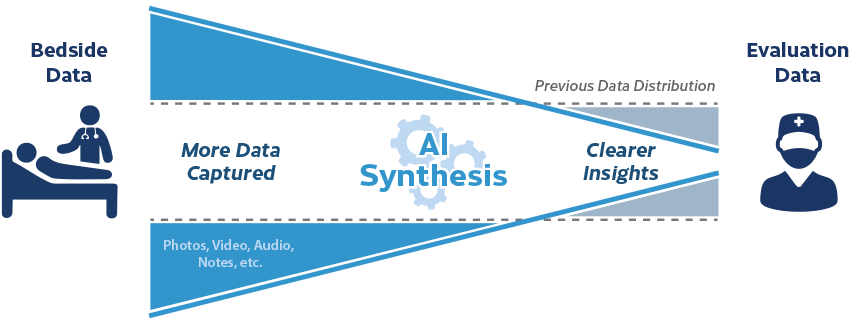
MOSAiCC enables the secure capture and sharing of data in that environment. More importantly, it facilitates the collection of additional unstructured data that may not be recorded in the hospital system but could be equally valuable.
“Our tools allow easy, secure methods of capturing unstructured data quickly and effectively,” says Lee. “This includes things like more ad hoc conversations, information from machines that are not integrated, graph shapes on device screens or even information from other outside services.”
No matter the upload method used, MOSAiCC keeps donor data in context – an essential factor for enabling the platform’s AI-generated summaries that support meaningful clinical decisions.
A Pipeline Built to “Move Data, Not People”
Once data is centralized, the real magic happens. Advanced diagnostic tools such as 3D volumetrics and AI-augmented image analysis can be “plugged in” to extract deeper insights.
Simultaneously, CompuMed’s remote group of sub-specialty physicians can quickly provide consistent, accurate, transplant-centered interpretations of all the incoming donor data and imaging. The entire pipeline is built to move data, not people, minimizing logistical burdens while maximizing efficiency.
As Lee puts it: “Capture it in digital format at the source in context and real-time; centralize it into a secure, HIPAA-compliant cloud-based platform; plug in the best tools – such as AI algorithms and sub-specialty clinical interpretations – and then electronically share verifiable results to decision-makers to empower the most informed decisions.”
The result is a streamlined, centralized process that delivers clear, verified and actionable insights to clinical decision-makers. This approach reduces evaluation times and improves the likelihood of organ acceptance – ultimately saving more lives through donation and transplantation.
For a deeper dive into CompuMed’s data capture tools, check out our blog, How CompuMed’s Data Capture Tools Are Helping OPOs Share the Right Information in Real-Time
You can also read more from this series on powering progress. Next up: See how MOSAiCC turns donor data into clear, actionable summaries in Clarity Unlocked – How AI is Transforming Donor Management.